
Our Solar and Powerwall Installation: 7.6kW of Panels, a Powerwall 3, and What We've Learned So Far
How we installed 7.6kW of solar panels and a Tesla Powerwall 3 on our all-electric home — the full cost, what went wrong with our installer, and early performance data from Suffolk.
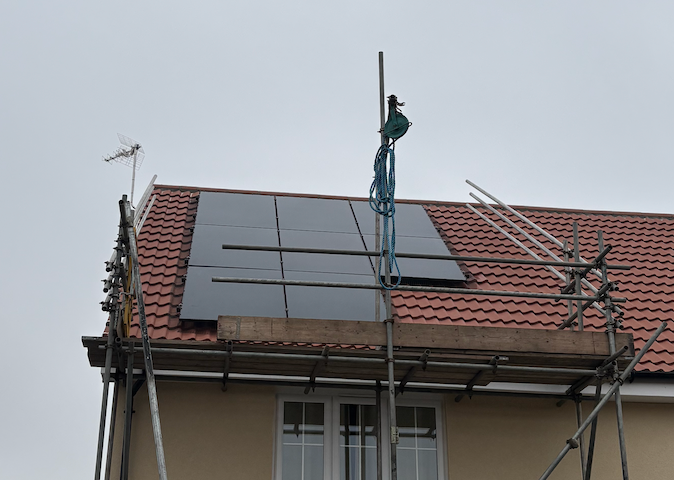
We'd wanted solar panels for a while. Moving into a new build in March 2025 gave us the push — a well-insulated house, a heat pump already installed, two EVs on the driveway, and an all-electric home with no gas supply. Solar and battery storage felt like the obvious next step. Here's how the whole process went, what it cost, what went wrong, and how the system is performing now that it's live.
Why We Went for Solar and Battery Storage
We're an all-electric household — no gas at all. Our heat pump, hot water, two EVs, and everything else runs on electricity. Around July 2025 we moved to the E-On Next Drive tariff, which gave us cheaper overnight electricity. That meant we could charge the cars, run the heating, and heat our hot water during the cheap window to keep costs down.
But during the day, our electricity was still at the higher rate — and with me working from home, we're using power throughout the day. That's what really drove the case for solar and battery storage. We needed to generate our own daytime electricity rather than buying it at peak rates.
Why the Powerwall 3?
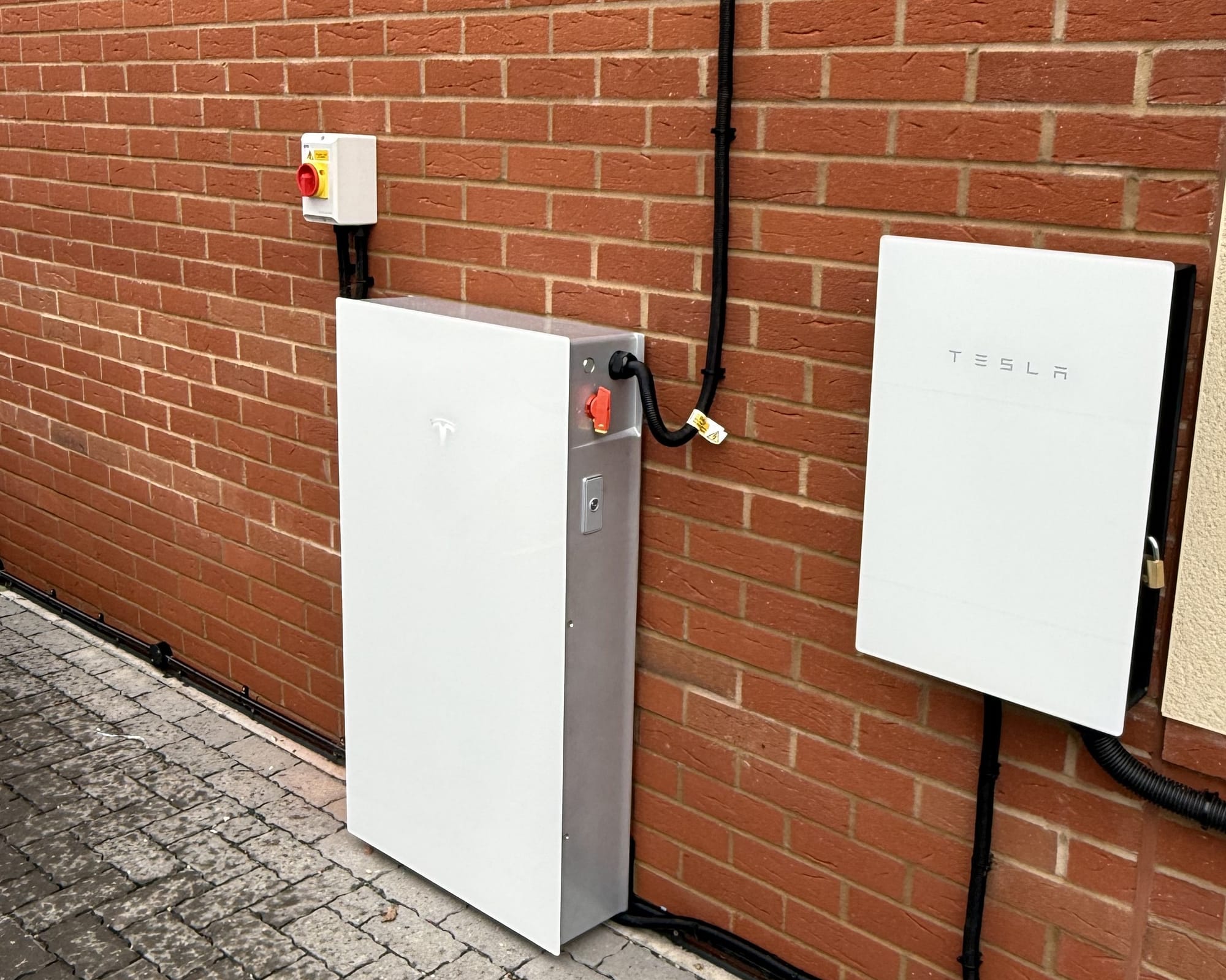
We looked at several battery options but kept coming back to the Tesla Powerwall 3. The main reasons were practical: it sits flush against the wall (it looks great), the inverter is built in (so no separate inverter box to find space for), and it can be expanded later if we need more capacity.
We'll be honest — we were reluctant to go with Tesla given the whole Elon Musk situation. But ultimately, it was the product that worked best for our setup, and we had to separate the product from the politics. Sometimes the best option is the best option.
The System We Chose
Here's what we ended up with:
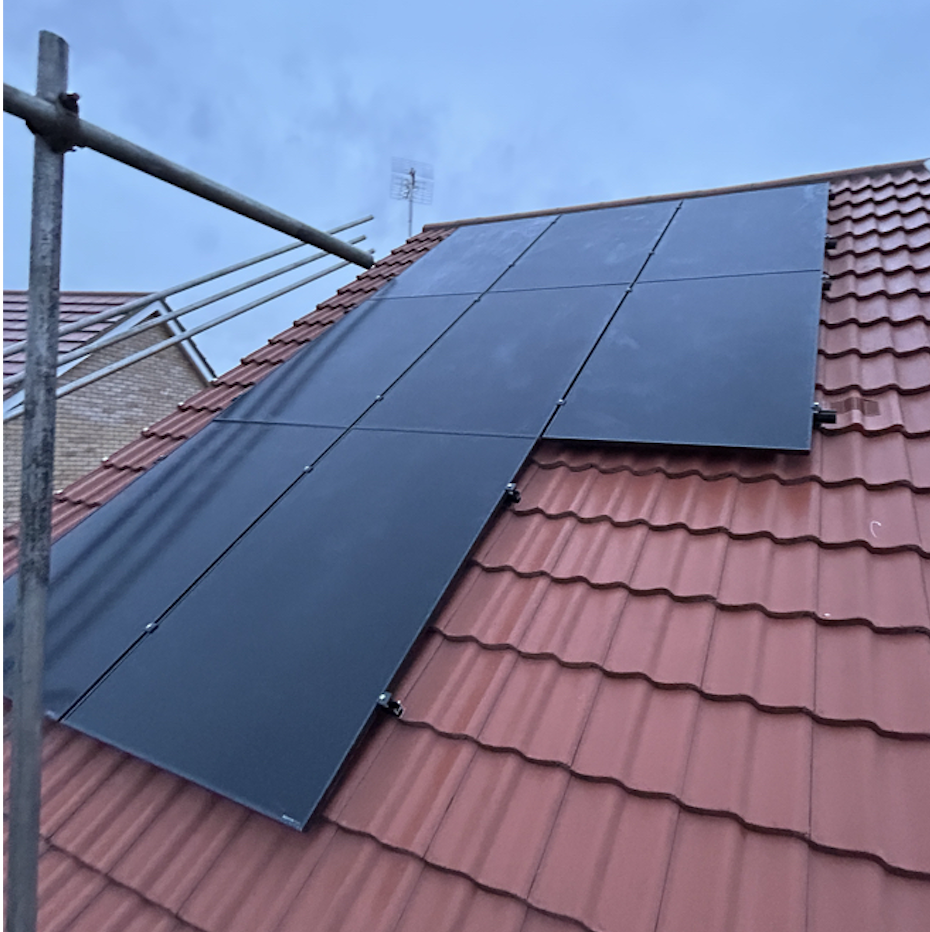
- 16 × Aiko Energy 475W panels (model: AIKO-A475-MCE54Mb) — giving us a 7.6kW system
- Tesla Powerwall 3 with Gateway for whole-home backup
- Pitched roof, east/west orientation — 8 panels facing east (front), 8 facing west (back)
- Bird netting around the panels
- Earth rod (required for Powerwall 3 with Gateway for whole-home backup)
The east/west split means we get generation across a longer part of the day — morning sun on the east-facing front panels, afternoon sun on the west-facing back panels. We also get a decent peak around midday when the sun is more or less overhead and both sets of panels are producing well. For our usage pattern, with someone home all day, this works nicely.
What It Cost
The total came in just under £15,000. That covers the 16 panels, the Powerwall 3, installation, earth rod, and bird netting.
The original quote was closer to £14,000. We ended up paying around £500 extra for the earth rod and another £500 for bird netting — both of which should have been included from the start (more on that below).
How We Financed It
We financed the installation through an interest-free loan via Lendology (lendology.org.uk). Lendology work with local authorities to provide finance for home energy improvements — in our case, it was through Suffolk County Council. Everything was handled by Lendology directly.
It's worth noting that as of now, Suffolk has paused this scheme, although their site suggests more may be coming later this year. If you're considering solar, it's worth checking whether your local authority offers anything similar through Lendology or other providers — interest-free finance makes a significant difference to the payback calculation.
The loan was approved in early summer 2025, but couldn't be finalised until the title deeds for our property were in our name. As a new build, this took longer than expected and wasn't resolved until the autumn. Once that was sorted, the paperwork was completed, and we advised Contact Solar to proceed. They then contacted the DNO (Distribution Network Operator) for G99 approval.
Choosing an Installer
We initially got a quote from Octopus Energy for the installation. We then approached Contact Solar, who matched the Octopus price. We went with Contact Solar because the person we dealt with was very charismatic and easy to speak with — they made the whole process feel straightforward and we felt confident in them.
The Installation — And What Went Wrong
We'll be fully honest here: the installation didn't go as smoothly as we'd hoped. This was our experience only, and other people may have had a completely different one, but we think it's important to share the reality.
The Timeline
- Early summer 2025: Started the process, loan approved through Lendology
- Autumn 2025: Title deeds resolved, loan finalised, Contact Solar advised to proceed
- December 2025: G99 DNO approval granted
- Late January 2026: Installation completed over two days
- Mid-February 2026: Return visit — cracked panel replaced, bird netting installed, front array connected
The gap between DNO approval in December and installation in late January was down to Christmas and needing to book scaffolding — not unusual, but worth factoring in if you're planning an install over winter.
The Problems
After the initial two-day install, several issues came to light:
A cracked panel. On the second day of the install, the team told us one of the panels on the back (west-facing) array was cracked. They said the west array couldn't work because of this, but told us the front (east-facing) array would be generating. It wasn't.
Front array not connected. When a second team came back a couple of weeks later, they discovered the first team hadn't connected the tails for the front (east) array. So for those two weeks, we had a Powerwall that was working but zero solar generation from any panels at all — despite being told the front array was live.
No bird netting included. The Octopus quote had included bird netting as standard. Contact Solar's matching quote didn't. When we raised it, we were initially told they normally charge £1,400 for netting, but could do a "special price" of £700. Even that didn't feel special to us. After some back and forth, we eventually agreed on £500 — but it shouldn't have been an extra cost at all.
No earth rod included. We'd been quoted for a whole-home backup system with the Powerwall 3 and Gateway — so why weren't we told an earth rod was required for that setup? It was included in the Octopus quote as standard, but Contact Solar charged us an additional £500 for it. If you're quoting someone for a whole-home system, the earth rod should be part of the price.
DNO confirmation delays. We had to chase repeatedly for confirmation that our G99 DNO approval was fully processed. In the end, we emailed the DNO ourselves to get a straight answer.
Export settings not enabled. We also had to chase Contact Solar to enable the option to choose between exporting solar only or exporting everything (including from the Powerwall).
MPAN still pending. As of mid-March 2026, we're still waiting for our MPAN (Meter Point Administration Number) to be sent from the DNO to Octopus Energy. This means we have DNO approval to export, but we don't have an export contract in place — so any energy we're sending back to the grid right now isn't earning us anything.
In Hindsight
If we were doing this again, we'd probably just go with Octopus Energy for the installation. Their quote included everything — bird netting, earth rod, the lot — and we suspect the post-installation support and paperwork handling would have been smoother. The price match from Contact Solar looked attractive, and the person we dealt with was great, but the extras we had to pay for and the chasing we had to do eroded any saving and caused unnecessary stress.
That said, this was only our experience. Contact Solar may be excellent for other customers — we can only share what happened with ours.
How Is the System Performing?
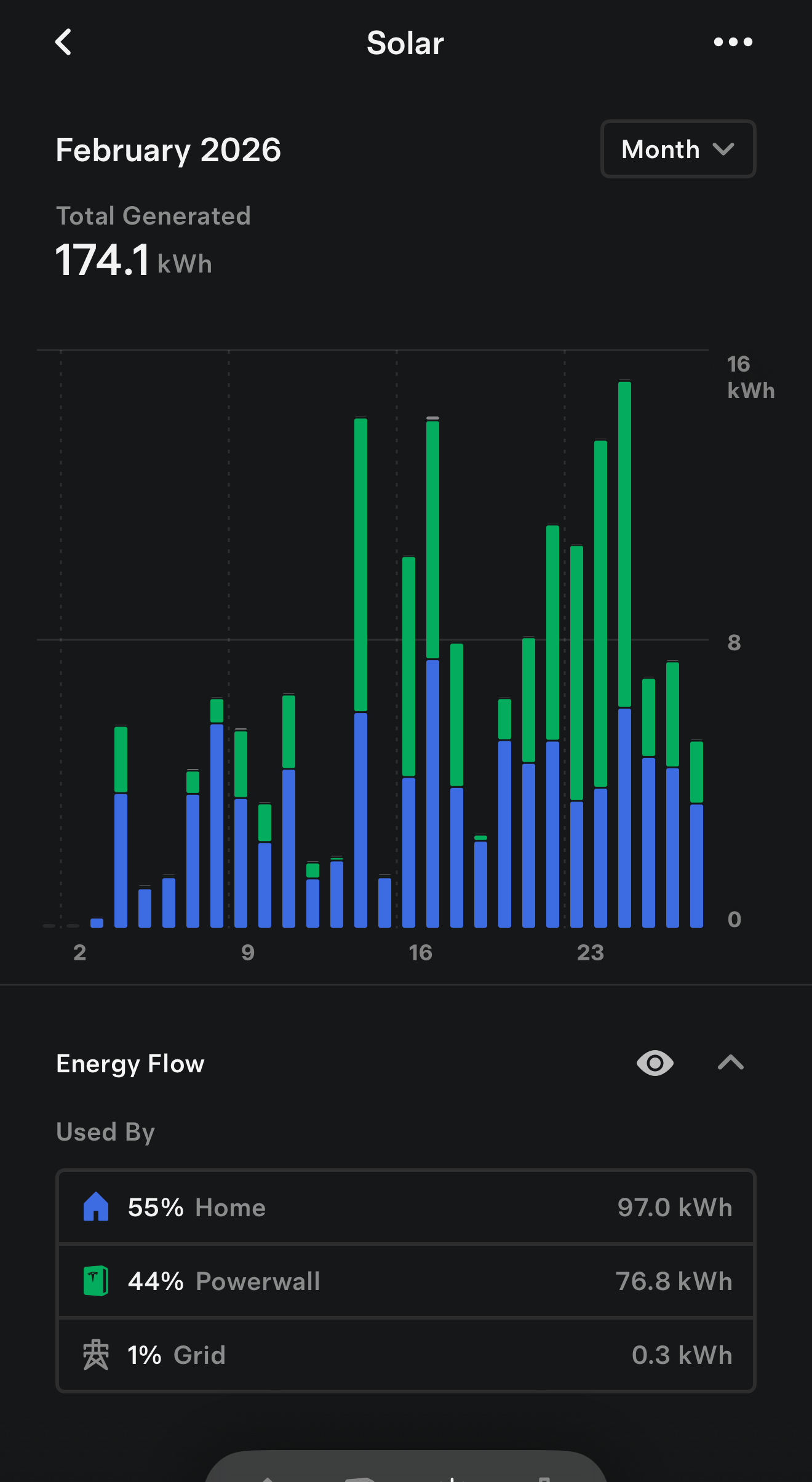
The system has been fully live since 2nd February 2026, when the second team completed the final panel replacement and connected the front array. So we're still in the early days. Here's what we've seen so far:
- February 2026 (from 2nd): 174.1 kWh generated
- March 2026 (first 15 days): 198.7 kWh generated
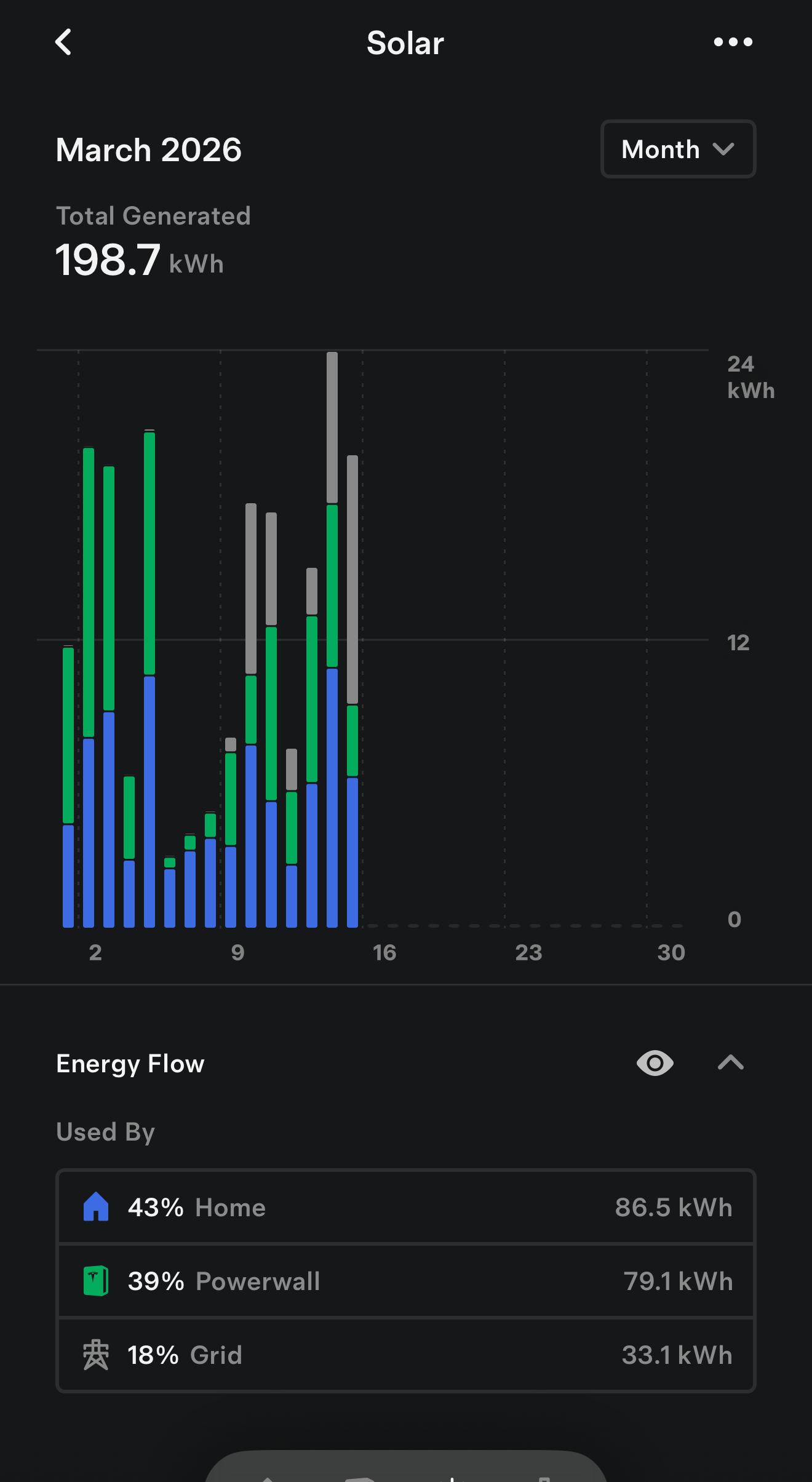
Bear in mind the February figure isn't a full month — it's from the 2nd onwards. Even so, for a 7.6kW system in Suffolk during the shortest, darkest month of the year, we're reasonably happy with that. March is already looking much stronger — we've passed February's total in just half the month, and the days are getting noticeably longer.
We're tracking everything through the Tesla app and Home Assistant, and we'll be publishing real-world generation data periodically as the year goes on. We're particularly interested to see what happens through spring and summer as the days lengthen and the sun gets higher.
What's Next
There are a few things we still need to sort out:
- Export contract. Once the MPAN is sent to Octopus, we can set up an export tariff and start earning from the energy we send back to the grid.
- Smart meter issues. We've had some problems with our smart meter which deserve their own post.
- Optimising self-consumption. We want to use Home Assistant to get smarter about when we charge the EVs, run the heat pump, and use high-draw appliances — timing everything around our solar generation rather than drawing from the grid.
- Generation reporting. We'll be publishing real generation data periodically so you can see what a 7.6kW east/west system actually produces in the east of England.
Would We Do It Again?
Absolutely. Despite the installation headaches, having solar and battery storage on an all-electric house makes complete sense. We're already seeing meaningful generation even in late winter, and as the days get longer we expect the system to really come into its own.
The key lessons from our experience:
- Get multiple quotes, but compare what's actually included — not just the headline price.
- Check your installer covers everything — earth rod, bird netting, DNO paperwork, export configuration. Don't assume anything.
- Budget for the unexpected. We went from around £14k to just under £15k because of items that should have been in the original quote.
- Chase your DNO paperwork. Don't wait for your installer to handle it — stay on top of it yourself.
- Consider going with your energy supplier for the install if they offer it. Octopus, for example, handles the whole process end to end, including DNO and export setup.
- Separate the product from the brand. We had reservations about Tesla but the Powerwall 3 was the best product for our needs. Sometimes you have to be pragmatic.
If you're considering solar in the UK, we hope this gives you a realistic picture of what to expect. We'll be documenting everything as we go — the good, the bad, and the real numbers. If you've got questions about our setup, feel free to get in touch.